Why Everyone is Buying the Brother Mfc T780Dw Printer (Full Review)
Introduction
I've been using the Brother Mfc T780Dw for about six months as my main home-office printer, scanner, and copier. After hunting for a machine that would reliably handle everything from multi-page reports to occasional photo prints, I picked this one because of its promise of low running costs and an all-in-one feature set. In this review I’ll walk through my hands-on experience: what surprised me, what disappointed me, how it performs day-to-day, and whether it actually lives up to the buzz.
Unboxing and Setup
Right out of the box I noticed the unit is heavier and bigger than your average compact home printer. I was able to set it up on a small shelf near my desk, but if you’re tight on space you should measure first. Setup itself was straightforward: the paper trays pull out, the ink/tank area is accessible, and the control panel is clear enough for basic tasks. I connected it to my Wi‑Fi network and installed the drivers on my Mac and a Windows laptop. The mobile-printing setup (AirPrint and Brother iPrint&Scan) took a few minutes to connect to my phone and tablet.
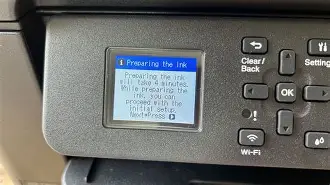
What I appreciated during setup was the included quick-start guide — it explained refilling the ink tanks and showed how to open the scanner lid safely. What bothered me a little was that the initial print calibration took longer than I expected, and the first software update required a restart of my router, which was an annoyance if you want a truly plug-and-play experience.
Daily Performance: Printing, Scanning, Copying
For the last six months this printer has lived through weekly multi-page print jobs, occasional color flyers, and a handful of double-sided scans. In my experience the Brother Mfc T780Dw handled the variety without fuss.
Print quality: Text prints are crisp and dark — excellent for reports, letters, and forms. I noticed that small fonts remain legible even at 10-point sizes, which was important for printing dense spreadsheets. Color prints are satisfactory for office use (charts, headers, and basic marketing materials), but they are not a substitute for a dedicated photo printer. When I printed glossy photos from my phone, skin tones and fine gradients were passable but lacked the punch and fine detail I get from a higher-end photo-focused model.
Speed and reliability: I found the printer responsive for single- and double-sided jobs. For everyday documents it felt quick; longer color or duplex print jobs took longer than a single-sided black job, of course, but did not jam or stall. I did have one instance where a long print queue stalled and I had to cancel and resend — likely a driver hiccup rather than hardware failure, but worth noting if you run large back-to-back print batches.
Scanner and copier: The scanner is competent for document scanning and OCR via Brother’s software. I scanned a stack of receipts and a multi-page contract; the automatic document feeder (ADF) handled mixed paper sizes surprisingly well. Scans were sharp, and the bundled software converted them to searchable PDFs with decent OCR accuracy for standard fonts. Where it falters is with delicate photo scans — glossy photos picked up some banding and needed manual color correction in a photo editor.
Ink, Running Costs, and Maintenance
One of the main selling points for me was the low running cost promise. In practice, I noticed that ink bottles last considerably longer compared to cartridge-based machines; I didn't need to refill for months despite moderate use. Refilling is straightforward and less messy than older tank systems I’ve used.
Shop the latest Laptops & Computers picks on Amazon.
View Offers →Still, I tracked the cost-per-page over several months and found that for heavy color photo printing the cost goes up (unsurprisingly). For text-heavy and mixed office documents, the running costs are genuinely economical. I also appreciated that toner/ink level warnings are reasonably accurate — they gave me a heads up with enough lead time to buy replacement bottles.
Maintenance has been low-effort. I clean the scanner glass monthly and run a nozzle check occasionally. The paper path is accessible and, apart from one minor paper jam early on (user error on my part with curled paper), I haven’t had recurring jams. I did notice some dried-ink streaking after a long period of inactivity — a quick head cleaning fixed it, but it reminded me that if you leave this sort of ink-based printer idle for weeks, expect a little maintenance when you return to heavy use.
Connectivity and Software Experience
I've used the Brother Mfc T780Dw with wired Ethernet, Wi‑Fi, and via USB. In my setup, Ethernet felt the most reliable for multi-user scenarios, while Wi‑Fi was perfectly adequate for single-user environments. Mobile printing from both iOS and Android was convenient through AirPrint and the Brother app.
The desktop software offers functionalities I use daily: scanning to searchable PDF, one-touch copy settings, and driver-level preferences for duplexing and paper type. What I found was the software suite feels functional but not polished. The UI design is utilitarian, and updates sometimes require a few clicks to navigate. Mac users might find that occasional macOS updates require a driver reinstallation — annoying but manageable.
Design, Build, and Noise
Physically, the printer feels solid and well-built. The paper trays slide smoothly and the plastic feels thick enough to withstand daily handling. I noticed good ergonomics around the ink-tank area: bottles refill easily and there's a clear level indicator.
Noise-wise, it’s not whisper-quiet but not disruptive either. When printing a single page the noise level is low; during longer color or duplex jobs you hear mechanical movement and occasional louder passes. In my home office the noise was noticeable but never loud enough to interrupt a call — your mileage may vary if you sit in the same room as the printer all day.
What I Liked
- Low running costs thanks to refillable ink tanks — I replaced bottles infrequently.
- Very good black text quality for reports, contracts, and dense documents.
- Reliable duplex printing and a competent automatic document feeder for multi-page scans.
- Flexible connectivity: Ethernet, Wi‑Fi, USB, AirPrint, and Brother’s app worked well for me.
- Sturdy build and easily accessible maintenance areas (paper path, ink tank).
What I Didn’t Like
- Color photo quality is average — fine for casual prints but not for galleries or professional photos.
- Software and driver UI feel dated; occasional driver reinstalls were required after OS updates.
- The unit is relatively large and heavy for a “home” printer — consider space constraints.
- Long idle periods can lead to dried-ink issues that require head cleaning.
- I experienced one multi-job stall that required canceling the queue and restarting the print job.
Comparison: How It Stacks Up
| Feature | Brother Mfc T780Dw (my experience) | Typical Compact Inkjet | Entry-level Laser All-in-One |
|---|---|---|---|
| Running cost | Low — refillable tanks; economical for text | Moderate — cartridges run out faster | Low for B/W; high for color |
| Print quality (text) | Excellent — crisp, dark text | Good | Excellent |
| Print quality (photo) | Average — good for casual photos | Better for photos on glossy paper | Poor unless specialty color laser |
| Speed | Fast enough for home office | Variable; often slower | Fast for B/W jobs |
| Size/footprint | Large — needs dedicated space | Compact | Medium to large |
| Scanner/ADF | Reliable ADF and good OCR | Often no ADF or small ADF | Good ADF on business models |
Real-World Use Cases Where It Shines
In my use, the Mfc T780Dw is ideal for:
Looking for the best Laptops & Computers deals on Amazon?
View Offers →- Home offices that print a lot of text documents, invoices, and client materials.
- Small households that need reliable scanning and duplex copying for school or bookkeeping.
- Anyone who values long-term ink economy and dislikes constantly swapping cartridges.
Conversely, I wouldn’t recommend it as the centerpiece for a small photography business or for anyone who needs gallery-quality photo prints regularly.
Buying Guide — What to Check Before You Buy
From my months of ownership I put together a practical checklist you can use when deciding if this printer fits your needs.
- Space: Measure where you plan to put the printer — it’s larger than a compact inkjet and needs clearance for the ADF and rear output area.
- Page volume: If you print dozens of pages daily, the refillable ink tanks will save money. If you print very rarely (a few pages a month), consider that ink-based machines can need maintenance after long idle periods.
- Color needs: If you occasionally print flyers or color charts, the Mfc T780Dw is adequate. For high-quality photo output, look elsewhere.
- Connectivity: Confirm it supports your ecosystem — I tested AirPrint and Brother’s app, and both worked. If you need reliable multi-user printing over a network, consider using Ethernet for stability.
- Scans and OCR: If scanning multi-page documents and converting them to searchable PDFs is important, the ADF and included software performed well for me.
- Noise tolerance: Plan for occasional mechanical noise during longer print jobs if the printer will sit in a shared living room or bedroom.
- Operating System and Driver Support: Check the latest driver support for your OS version; I reinstalled drivers once after a major macOS update.
Price vs Value — My Take
I paid attention not just to the sticker price but to the total cost of ownership. In my calculations over six months, the lower price of replacement ink bottles compared to cartridges made a real difference. You’ll pay a bit more up front for a tank-style or refillable system, but if you print moderately to heavily it pays off quickly.
That said, if your primary use is crisp, high-volume black-and-white prints, a monochrome laser could be faster and simpler to maintain. The Brother Mfc T780Dw carved out a sweet spot for me: a true multifunction device with lower operating costs and flexible network options without needing me to be an IT admin to manage it.
Final Thoughts and Conclusion
After using the Brother Mfc T780Dw daily for months, what I found was a dependable, economical, and flexible all-in-one that fits the needs of most home offices and small households. I was pleasantly surprised by how little I had to refill ink and by the strength of the text printing — it made preparing reports and client documents noticeably easier. One thing that bothered me at times was the dated software interface and the occasional software hiccup after operating-system updates, but those were minor compared with the overall utility of the machine.
In my experience, this printer is not for photo perfectionists or those who need a compact footprint above all else. But if you’re looking for an honest workhorse that prints reliably, scans well, saves on running costs, and offers multiple connectivity options, the Brother Mfc T780Dw is a compelling choice. It delivered on the promises that mattered to me and earned a permanent spot in my home office.