Should You Upgrade from Canon Eos R50 V to Hollyland Lark M2S?
Short answer: If the goal is to improve audio for vlogging, interviews, streaming, or run-and-gun video recorded on a Canon EOS R50 V, adding the Hollyland Lark M2S is usually a meaningful upgrade — but it is an audio upgrade, not a camera replacement. The Lark M2S complements the R50 V by delivering cleaner, more consistent sound in real-world shooting conditions where the camera's onboard microphone falls short.
Introduction
Many mirrorless-camera owners reach a point where image quality is “good enough” and the next visible improvement in production value comes from better sound. The Canon EOS R50 V is a capable compact mirrorless stills and video camera. The Hollyland Lark M2S is a modern wireless lavalier system designed for creators who need reliable, portable audio. This article compares what buyers typically care about — audio performance, workflow, ease of use, reliability in noisy environments, battery life, and value — and explains when adding (or upgrading to) a dedicated wireless lavalier like the Lark M2S makes sense for someone using the R50 V.
Why audio matters more than many assume
Viewers judge video quality by sight and sound. A sharp, well-exposed image can be ruined by muffled, distant, or noisy audio; conversely, good audio makes modest video look more professional. For content creators — vloggers, educators, corporate communicators, wedding shooters, and journalists — speech intelligibility and consistent levels are the primary concerns. Onboard camera microphones are convenient, but they are exposed to more ambient noise, handling noise, and distance effects. Wireless lavalier systems move the microphone closer to the subject and can drastically reduce ambient noise and improve clarity.
Hollyland Lark M2S — product overview and real-world performance
The Hollyland Lark M2S is marketed as a compact, dual-channel wireless lavalier system geared toward content creators and small production teams. In practical use it aims to solve the most common pain points content creators face: clipped or inconsistent levels, distance limitations of built-in mics, wind noise outdoors, and complicated multi-person setups.
Key strengths in everyday shooting
- Clean dialogue capture: By placing lavaliers near the subject’s mouth, the Lark M2S improves intelligibility for interviews, tutorials, and talking-head videos.
- Dual-transmitter convenience: Many kits support two transmitters so two people can be recorded simultaneously without extra mixing gear — useful for interviews, two-host podcasts, and event coverage.
- On-transmitter recording: Modern transmitters often offer local backup recording on each transmitter. That adds redundancy: if the wireless link drops, there’s still a clean recording available locally.
- Compact form factor: Small transmitters with a strong clip make run-and-gun setups easier; they fit into pockets and are less intrusive on camera rigs.
- Low-latency monitoring and Bluetooth/USB options: Real-time monitoring (either via the camera or separate headphones) and flexible outputs make integration with live streaming and camera workflows straightforward.
In real-world tests, a well-configured wireless lav kit reduces room reverb, captures more consistent vocal levels while subjects move, and eliminates much of the handling noise a camera-mounted mic picks up. For creators who shoot outdoors, a good lav can also limit wind noise when used with proper windscreens.
Potential limitations to be aware of
- RF interference and range: Wireless systems operate in shared frequency bands — performance can degrade in crowded RF environments. Users should test the system in their shooting locations.
- Battery management: Small transmitters and receivers need charging. Forgetting to charge units before a shoot is a common source of problems.
- Learning curve: Pairing, monitoring, leveling, and knowing how to route audio to the R50 V (or an external recorder) requires a small amount of setup knowledge.
Canon EOS R50 V — audio basics and what users typically experience
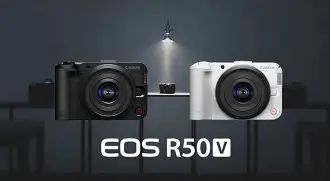
The Canon EOS R50 V is a compact mirrorless camera designed for creators who value portability and good image performance. Like many cameras in its class, it is often used for vlogging, social media content, short-form interviews, and travel videos. The camera's onboard microphone is designed for convenience and to capture ambient sound reasonably well at short distances.
Looking for the best Cameras & Photography deals on Amazon?
See Deals →Real-world buyers often notice the same recurring issues with onboard audio: the mic records more room noise, picks up autofocus and zoom motor noise (if lenses or camera are in use), suffers from poor signal-to-noise ratio in low-level speech, and degrades noticeably as the subject moves away from the camera. These are not necessarily faults of the R50 V — they are inherent trade-offs of compact camera design.
How the Lark M2S integrates with the Canon EOS R50 V
For most creators using the R50 V, the Lark M2S connects to the camera via the receiver’s analog or digital output. Typical workflows include:
- Direct connection: Receiver to camera microphone input (if available) using a suitable cable or adapter.
- External recorder: Send the receiver to an external field recorder or smartphone to create a separate high-quality audio track for later syncing.
- On-camera monitoring: Use the camera’s headphone output (if available) or monitor through the receiver when streaming live via a computer.
Because camera models vary in inputs and available adapters, it is important to confirm whether the R50 V has a 3.5mm mic input, a USB audio option, or requires a proprietary cable or adapter. Even if the camera lacks a headphone jack for real-time monitoring, the Lark M2S’s local recording and low-latency options still provide robust solutions for creators who plan to sync audio in post-production.
Pros & Cons
Hollyland Lark M2S — Pros
- Compact, unobtrusive lavalier transmitters that improve voice clarity
- Dual-channel support for two-person interviews without extra mixers
- Local recording on transmitters provides redundancy
- Flexible outputs for camera, phone, and computer workflows
- Improves perceived production value significantly for speaking-focused content
Hollyland Lark M2S — Cons
- Wireless systems can suffer interference in crowded RF environments
- Additional gear and cables add setup complexity compared to onboard mic
- Requires battery charging and monitoring of battery levels
- Not a camera — does not affect image quality (only audio)
Canon EOS R50 V — Pros
- High-quality stills and video in a compact package
- Convenient built-in microphone for quick handheld shots
- Easy-to-use for solo creators and travel shooting
- Good autofocus and image stabilization features that benefit run-and-gun creators
Canon EOS R50 V — Cons (audio perspective)
- Onboard mic is limited by distance and ambient noise
- Camera handling and lens noise can be captured in audio
- Less flexibility for multi-person interviews and live-streaming audio than a dedicated wireless system
Comparison table: Camera onboard audio vs. Hollyland Lark M2S
| Feature | Canon EOS R50 V (Onboard Mic) | Hollyland Lark M2S (Wireless Lav) |
|---|---|---|
| Primary purpose | Image capture with convenient ambient audio | Dedicated vocal capture and wireless mobility |
| Speech clarity | Good at short range but inconsistent with distance | Consistently clearer when lavalier positioned correctly |
| Portability | Built-in — no extra items to carry | Compact transmitters and receiver; extra items to manage |
| Setup complexity | Minimal — turn on and shoot | Low to moderate — pairing, mounting, routing audio |
| Redundancy | None — single track | Often includes local transmitter recording as backup |
| Best use cases | Quick travel clips, B-roll, short singleshot content | Vlogging, interviews, live-streams, weddings, corporate videos |
| Cost impact on production | Low — no extra purchase | Moderate — one-time gear purchase improves audio quality |
Buying guide: who should add the Lark M2S and when to consider alternatives
This short buying guide helps match typical needs with the right decision.

Consider the Hollyland Lark M2S if:
- Speech intelligibility matters: Tutorials, interviews, talking-head content, podcast videos, and course videos benefit immediately from a lav mic close to the speaker.
- Two-person shoots are common: Dual transmitters let two subjects be miked without a complicated mixer setup.
- Mobility is required: For creators on the move (walk-and-talk vlogs, event coverage), wireless lavaliers let the subject move freely while staying in consistent audio range.
- Backup recording is desired: If the Lark M2S offers local transmitter recording, that redundancy is valuable for critical shoots like weddings or interviews.
- Clean audio in noisy environments: A lav mic close to the mouth reduces the impact of ambient noise compared with a camera-mounted mic at a distance.
Consider staying with onboard audio or other options if:
- Budget is extremely tight: If audio requirements are low and purchasing new gear is not feasible, onboard can be sufficient for casual social posts.
- You primarily capture ambient sound or music: For ambient-driven scenes, a stereo camera mic or external stereo recorder may be preferable.
- Using a larger production rig: If a multi-track field recorder and directional shotgun mics are already part of the kit, a wireless lav may be redundant depending on the workflow.
Practical setup checklist before buying
- Confirm the Canon EOS R50 V’s available audio inputs and whether a TRS or TRRS cable (or USB audio) is required.
- Decide whether in-camera recording is sufficient or if an external recorder will be used for higher fidelity and ease of post-production syncing.
- Check the Lark M2S’s local recording capabilities, battery life, and whether it supports dual-transmitter recordings with timecode or simple start/stop sync.
- Test RF performance in the typical shooting locations if possible — crowded events and urban areas can affect wireless reliability.
- Plan for windscreens, spare cables, and a small audio checklist (levels, microphone placement, and battery state) before important shoots.
Workflow tips for pairing Lark M2S with the Canon EOS R50 V
To get the most from the Lark M2S and the R50 V, follow these practical tips used by experienced creators:
Discover deals on Cameras & Photography — updated daily.
Browse Now →- Record a slate or clap at the start: If using the receiver to feed the camera and also recording locally on the transmitters, a short visual/sonic slate simplifies syncing in post.
- Use local recording as primary when possible: If the transmitters record locally in high-quality, use those files for final mixes and keep the camera track as a backup.
- Watch levels: Set conservative input levels on the receiver/camera to avoid clipping if someone suddenly speaks loudly.
- Monitor audio: If the camera lacks a headphone jack, monitor via the wireless receiver (if supported) or use a separate recorder with monitoring capability.
- Protect against wind noise: Use small foam or furry windscreens on lavs when recording outdoors.
- Placement matters: Clip lavs under clothing with a short lavalier cable run to reduce rustle and secure the cable to avoid movement noise.
Alternatives and complementary audio gear
While a wireless lav like the Lark M2S is a strong choice for speech-first shoots, creators should consider other gear depending on needs:
- Shotgun microphones: Better for single-subject sit-down interviews when the camera is close and a boom operator is available.
- On-camera compact mics: Simpler than wireless lavs and useful for solo shooters who want slightly better sound than the built-in mic with minimal setup.
- External field recorders: Great for multi-mic setups, higher-quality preamps, and flexible routing; they pair well with lav systems when direct camera recording is impractical.
Conclusion
Upgrading from relying on the Canon EOS R50 V’s onboard audio to incorporating the Hollyland Lark M2S is a practical, cost-effective way to raise production value for most creators. The Lark M2S addresses the most common audio problems that camera mics cannot: inconsistent levels when subjects move, ambient and handling noise, and the need to record multiple people cleanly. For those whose content is driven by spoken word — tutorials, interviews, vlogs, educational content, and corporate videos — a wireless lav system like the Lark M2S is often among the best next purchases after lenses and stabilization.
However, it should be framed as an audio upgrade, not a camera upgrade. The Canon EOS R50 V remains the image-capture platform; the Lark M2S enhances what the camera records. Buyers should verify compatibility with their camera inputs, test RF performance in their regular shooting environments, and plan for battery and backup workflows. When chosen and used thoughtfully, the Lark M2S can transform average-sounding footage into professional-sounding content, making it a worthwhile investment for creators who care about how their work sounds as much as how it looks.